

I used to believe that good work would speak for itself.
I would prepare carefully, notice what needed attention, finish what I had agreed to do, and try to make things easier for the people around me. I assumed that would be enough.
Then came the performance review.
My manager asked what I had contributed over the past few months. It was a reasonable question. I knew I had worked hard. I had solved problems, supported projects, and handled details that helped things move forward.
But sitting there, trying to explain my value clearly, I realised that much of my work had already disappeared into the process. The difficult parts were over. The problems I had prevented had never become visible. The project was moving, so the care behind it was easy to miss.
I had done the work. I just had not prepared a story about it.
That moment stayed with me because I know many introverts experience something similar. We often expect the quality of our work to be noticed without having to talk about it too much. But in many professional environments, people are expected to communicate their progress, speak about their contributions, ask for opportunities, and make their goals clear.
None of that means you need to become louder. It means you may need a quieter, more deliberate way to be seen at work.
Visibility is not self-promotion
For a long time, I thought workplace visibility meant talking about yourself more often.
I imagined it as being the person who always had an update, always had an opinion, and knew how to describe every accomplishment in a confident way.
That kind of self-promotion can feel uncomfortable when you prefer to let your work speak for itself. It can even feel as though you are exaggerating, although everything you are saying is true.
But visibility does not have to mean making yourself the centre of attention.
It can simply mean making your work easier to understand.
That might look like:
- sharing a short progress update;
- explaining a decision and its impact;
- documenting something you improved;
- naming a problem you helped prevent;
- or asking directly about the next opportunity you would like to explore.
People cannot always see the thinking behind your work. They may not know how carefully you prepared, what you noticed early, or why a project moved smoothly because you handled something before it became a problem.
Good work can become invisible when it leaves no clear trail behind.
Leave a quiet trail of your work
You do not need to announce every task. A short, useful update is often enough.
You might write:
I completed the first review and found two issues that could affect the timeline. I’m checking the impact today and will share a recommendation by Thursday.
This does not say, “Look how impressive I am.”
It says, “This is what I am working on, this is what I have noticed, and this is what happens next.”
That kind of communication helps your manager and your colleagues understand where things stand. It also gives your contribution a place in the project record.
At the end of each week, you can keep three short notes for yourself:
- Completed: What did I finish?
- Contributed: What did I improve, support, clarify, or prevent?
- Continuing: What am I working on next?
This is especially helpful before a one-to-one, performance review, or conversation about growth. You will not have to search your memory for evidence that you have been working hard. You will have something concrete to refer to.
You are allowed to think before you speak
Meetings can move quickly. People often brainstorm out loud, respond immediately, and move from one idea to the next before you have finished forming your own.
If you need time to think, it can be easy to mistake that for a lack of confidence.
It is not.
You can prepare one sentence before a meeting. It might be an observation, a question, a recommendation, or a concern you want to make sure does not disappear.
For example:
One thing I would like us to consider is how this change will affect the current onboarding process.
Or:
I want to give that a thoughtful answer. Can I come back to you this afternoon?
You can also follow up in writing after the meeting:
I’ve had a chance to think about our discussion. My recommendation is to move forward with option B because it addresses the main issue without adding another step to the process.
A thoughtful response later is often more useful than a rushed response now.
Your silence is not proof that you have nothing to contribute. Sometimes it simply means your thoughts are still becoming clear. I’ve written more about the difference between silence and having nothing to say here.
Say what you did without making it smaller
Introverts often soften their words before anyone else has had the chance to evaluate them.
“I only helped with…”
“I just wanted to mention…”
“This may not be important, but…”
These phrases may be habits. They may also be an attempt to avoid sounding arrogant. But when you minimise your contribution too often, people may hear less than you intended to say.
You do not have to become boastful. You can become more precise.
Instead of:
I only helped with the research.
Try:
I completed the research and summarised the findings for the team.
Instead of:
I just wanted to check in.
Try:
I’m following up on the decision we discussed and confirming the next step.
Instead of:
I’m not sure this is useful, but I noticed a problem with the timeline.
Try:
I noticed a potential issue with the timeline. Here is where I think we may need more room.
There is no performance in stating what is true.
You are not claiming to be the most important person in the room. You are simply allowing people to understand what you actually did.
Reliability does not mean instant availability
Being visible does not mean replying immediately to every message.
Some situations genuinely need a quick response. But not every request is urgent, and being constantly reachable is not the same as being reliable.
For introverts, that constant state of being “on” can also create the kind of exhaustion that nobody else can see.
You can make your working rhythm clear without over-explaining it:
I’m focusing on project work this morning and will respond to messages after 1 p.m.
I’m away from my desk this afternoon. I’ll review this tomorrow morning and let you know if I have any questions.
I can take this on, but I won’t be able to complete it by Friday. Tuesday is a realistic deadline.
That last sentence is not a failure to be helpful. It is accurate communication.
Agreeing to an impossible deadline may feel easier in the moment, but it does not protect the quality of your work or help the team plan clearly.
A boundary can be a form of reliability.
Connection without performance
Professional visibility is not built only in meetings or reviews. It is also built through small, genuine relationships.
For an introvert, networking can sound like another requirement to become more social and comfortable approaching strangers. But connection does not have to mean collecting contacts or making conversation in every room.
Sometimes it is one thoughtful exchange with a colleague.
You might ask how a project is going. You might thank someone for explaining a process. You might share a resource related to a problem they mentioned. You might follow up on an idea from an earlier conversation.
This is connection without performance.
You are not trying to make everyone remember you. You are allowing the people you work with to understand how you think and what kind of colleague you are.
Over time, that matters. People remember the colleague who is thoughtful, dependable, clear, and good to work with. You do not need to be known by everyone. You need to be understood by the right people.
The next performance review can be different
The next time someone asks what you have contributed, you do not have to improvise an answer.
Keep a quiet record throughout the year. Write down the projects you completed, the problems you helped solve, the processes you improved, and the feedback you received.
Then you can say something like:
Over the past few months, I took ownership of the client handoff process, reduced confusion around the next steps, and created a clearer record for the team. I would like to discuss opportunities to contribute at that level to the next project.
That is self-advocacy, but it does not require you to invent a bigger version of yourself. It is a skill many introverts have had to learn while navigating the pressure introverts feel when professional situations become a performance.
You are simply giving your work the words it needs.
You do not have to perform extroversion
There may be moments when someone else speaks first and receives the attention. There may be meetings where confidence is mistaken for competence, or constant participation is mistaken for commitment.
That can be discouraging.
It can make you wonder whether you need to become more outgoing, more available, or more comfortable turning every accomplishment into a story about yourself.
But your professional growth does not have to depend on becoming someone else.
You can make your work visible without making your entire personality public. You can communicate your contribution without performing confidence you do not feel. You can build professional relationships without turning every interaction into networking.
Visibility can be quiet, consistent, and honest.
The goal is not to make everyone notice you all the time.
The goal is to make sure the right people can recognise the value of what you already bring.
A quieter way to be seen at work
If you want to work through these ideas more deliberately, I created Quiet Visibility at Work—a practical workbook for introverts who want to communicate their contribution, prepare for difficult conversations, and build a professional presence that feels sustainable.
It includes reflection prompts, meeting preparation exercises, calm communication scripts, and practical ways to make your work easier to understand without performing extroversion.
You can use the fillable version on your computer or print the workbook and write by hand.
You do not have to become louder to be visible.
You only need a way of being seen that still feels like you.
A closer look at Quiet Visibility at Work
Quiet Visibility at Work was created to be used slowly.
It is not a workbook you need to finish in one sitting. You can begin with one question, one page, or one small change that feels useful today.
Here is a closer look at what is inside:

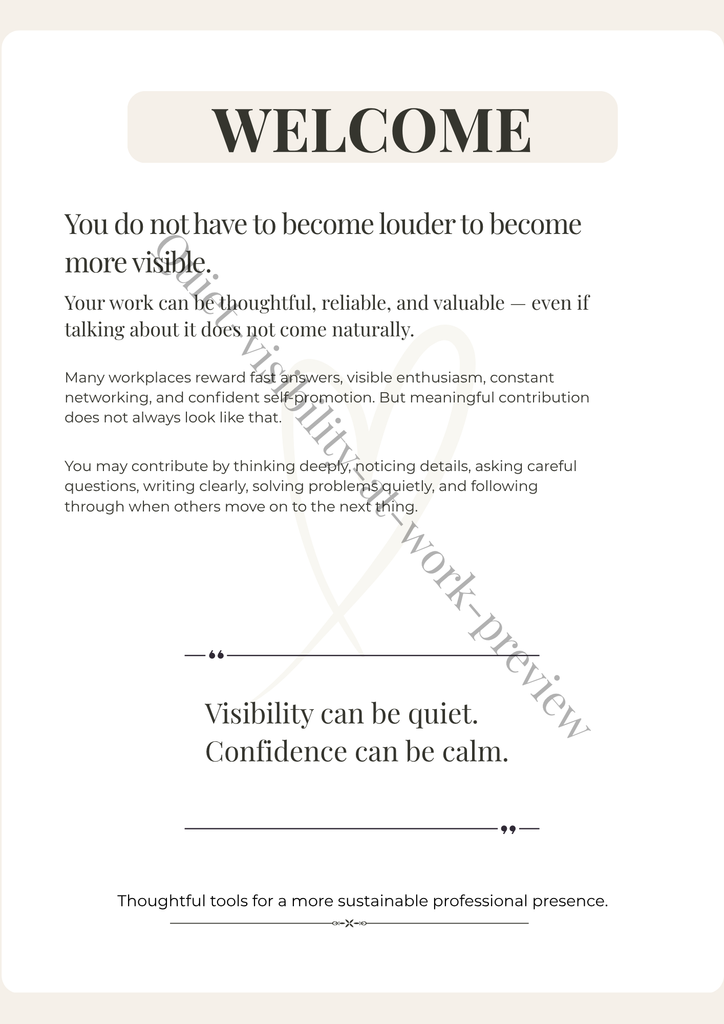
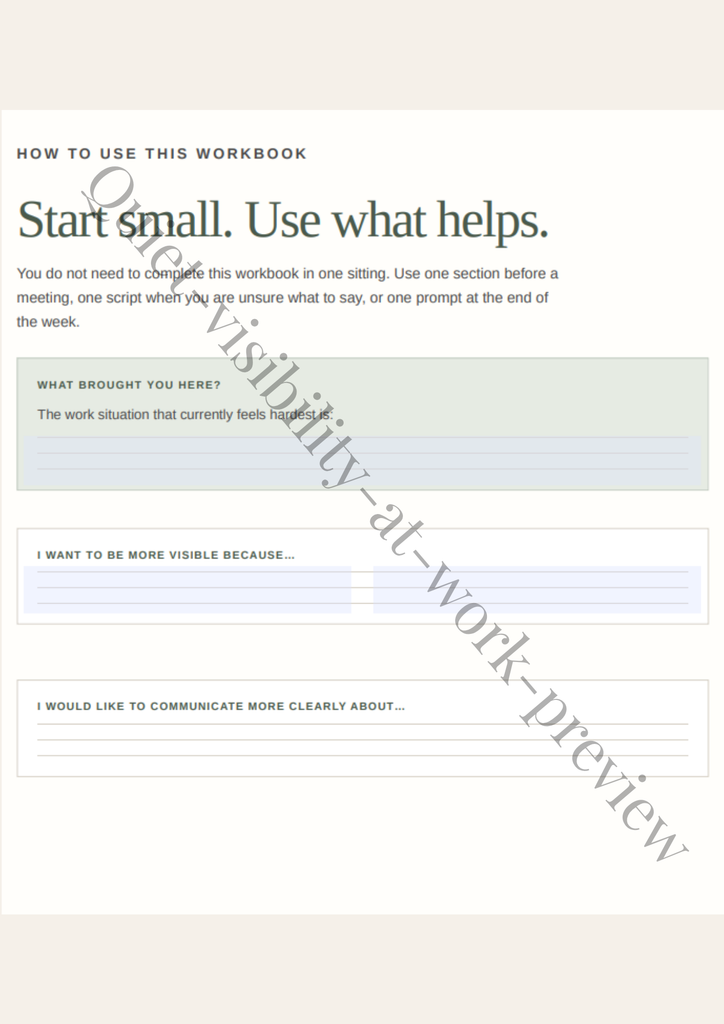
The full workbook includes interactive writing fields, printable pages, and a Read Me guide to help you use it comfortably on desktop or in print.
You do not have to become louder to be visible.
You only need a way of being seen that still feels like you.
Ready to Build Your Own Quiet Systems?
If any of this felt familiar, the free 7-day guide goes deeper: The Introvert’s Energy Audit. It helps you pinpoint exactly where your energy is leaking — and gives you a way to protect it for good.